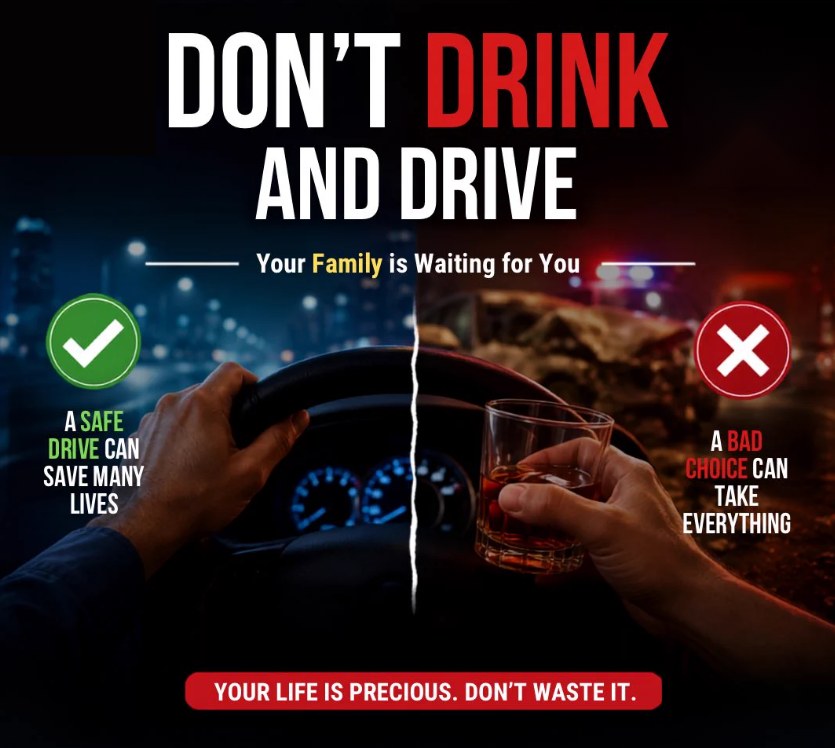
Impaired or exhausted doesn't feel dangerous. That's exactly the danger.
Alcohol — and plain exhaustion — impair the same judgment you'd use to notice something's wrong. Here's what the data actually says about drunk and drowsy driving, and why calling ROADDD is the easier call, not just the safer one. We only care about one outcome: you, home, safe.
Impairment starts long before you'd guess.
Blood alcohol concentration (BAC) doesn't have to hit the legal limit to affect your driving. Coordination, reaction time, and judgment all decline in stages — and the research shows people are consistently unable to feel the early stages happening.
| BAC | What it feels like | What it does to your driving |
|---|---|---|
| 0.02% | Mild relaxation, slightly warmer mood — most people report feeling completely normal. | Measurable decline in visual tracking and the ability to do two things at once, like watching the road and checking a mirror. |
| 0.05% | Looser inhibitions, exaggerated confidence — this is where most people insist they're "fine to drive." | Reduced coordination and steering control, slower reaction to sudden hazards. |
| 0.08% | The legal limit in every state but Utah (0.05%) — yet subjective "fine" feelings often persist. | Concentration and short-term memory drop sharply. Crash risk is roughly 4x that of a sober driver. |
| 0.15% | Clear loss of balance and speech in most people — well past any reasonable self-assessment. | Crash risk climbs to at least 12x that of a sober driver. |
Source: NHTSA drunk-driving risk data. Individual response varies by weight, sex, food intake, and tolerance — there's no way to reliably self-estimate BAC.
The most dangerous symptom of impairment is not noticing it.
A randomized, placebo-controlled driving study found something unsettling: drivers whose actual performance measurably worsened at legal-limit BAC levels rated their own confidence in their driving ability as unchanged. The brain that's supposed to flag the impairment is the same brain that's impaired.
"I only had two drinks, I'm fine."
Reaction time and lane control can measurably decline below the legal limit — before most people notice any change at all.
"It's a short drive, I know these roads."
Crash risk is about the drinking, not the distance — most alcohol-related crashes happen close to home, on familiar roads.
"I'll just drive slow and careful."
Impairment affects judgment and reaction time, not just speed control — the driving that matters most is the split-second response you don't get to plan for.
Being too tired to drive is its own DUI.
Fatigue produces the same failures alcohol does — slowed reaction time, poor decisions, drifting out of your lane — and it's easy to underestimate because there's no drink to count. Reporting also lags badly here: police-recorded numbers land near 700–800 deaths a year, but researchers who account for underreporting put the real toll far higher.
Sources: NHTSA drowsy-driving crash statistics; CDC drowsy driving research; AAA Foundation for Traffic Safety, "Drowsy Driving in Fatal Crashes, 2017–2021."
A DUI costs more than a bad night. It costs years.
Even a first-time DUI with no crash and no injuries runs into real money — fines, legal fees, mandatory education programs, license reinstatement, and years of inflated insurance premiums on top. A ROADDD ride is a fraction of that cost, backed by a professional driver and full coverage on your vehicle — the responsible choice ends up being the far cheaper one too, it just isn't why you'd make it.
- Typical total cost of a first-time DUI, fines through reinstatement
- Vehicle towed and impounded the same night
- Insurance premiums often rise 80–400% for years
- License suspension and possible job impact
- Typical fare for a professional, premium in-city ride
- Your car comes home the same night, in your driveway
- No morning trip to retrieve it, no tow lot
- Licensed, background-checked driver, fully insured trip
If there's any doubt, that's the answer.
You don't need to be sure you're impaired or exhausted to call. Drinking, no sleep, a long shift, medication — if you're wondering whether you should drive, that's the answer. We only care about one thing: getting you home safe.